

Linked Data: Unlocking public good from citizens personal information
Controversies in the Data Society 2026
Use of linked public sector administrative data for research
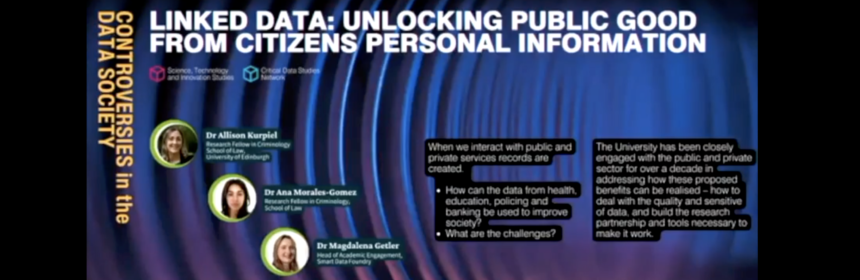
When we interact with public and private services records are created. How can the data from health, education, policing and banking be used to improve society? What are the challenges? The University has been closely engaged with the public and private sector for more than a decade in addressing how these proposed benefits can be realised – how to deal with the quality and sensitivity of data, and build the research partnership and tools necessary to make it work.
In this session, we hear perspectives from criminological scholars working with public sector administrative data – Ana Morales-Gomez and Allison Kurpiel – and industry leaders – Smart Data Foundry – who are working to unlock the power of privately held financial data.
Speakers
Dr Allison Kurpiel Research Fellow in Criminology, Edinburgh Law School, University of Edinburgh
Dr Allison Kurpiel is a post-doctoral Research fellow in Criminology based in Edinburgh Law School at the University of Edinburgh. She conducts research in collaboration with the Scottish Centre for Administrative Data Research and Professor Susan McVie. Her current work focuses on youth violence exposure and offending as well as police contact/calls related to mental health distress. She received her PhD degree in Criminology from the Pennsylvania State University (US) in May of 2024, where she conducted research primarily on youth victimisation, school violence, discriminatory bullying and the interplay between child welfare and juvenile justice systems involvement.
Dr Ana Morales-Gomez Research Fellow in Criminology, Edinburgh Law School, University of Edinburgh
Dr Ana Morales-Gomez is a Research Fellow at Edinburgh Law School, contributing to the ESRC-funded Scottish Centre for Administrative Data Research (SCADR). Ana is an applied statistician with a background in Sociology and Public Policy, with experience analysing survey and administrative data in both Chile and the UK. Her research focuses on applying quantitative methods to explore social inequalities, particularly ethnic disparities in sentencing, violence, imprisonment, and recidivism.
Use of linked public sector administrative data for research
Abstract
This talk describes the challenges of conducting robust, policy-oriented criminological research highlighting how linking public sector administrative data, such as health and criminal justice data, offers a potential solution to these challenges. Using real-world examples from the UK, we illustrate what administrative data research in criminology entails in practice and summarise the general process involved. We also explore the potential problems and controversies with research that links health and justice administrative data, addressing ethical dilemmas, access barriers and data-quality concerns. By situating administrative data research within the broader context of criminology and the social sciences, this talk aims to spark critical reflection on its role in a data-driven society and provide considerations for evaluating its implications for research, policy, and practice.
Speaker
Dr Magdalena Getler Head of Academic Engagement, Smart Data Foundry
A creative thinker and thoughtful leader with over 15 years of experience in open data advocacy, research and development, innovation, strategy, and technology, alongside a stellar research and evidence-gathering background. Magdalena has led research programmes and the design and development of products and services across the private, public, and not-for-profit sectors, as well as a startup environment (Smart Data Foundry, University of Edinburgh, Digital Curation Centre, BBC, Art Institute of Chicago).
Entrepreneurial and a fast learner, Magdalena has held leadership roles in the media, higher education, and finance sectors. She is an alumnus of a prestigious Aurora women’s leadership programme, selected from hundreds of applicants to represent the University of Edinburgh in 2018. As Head of Academic Engagement at Smart Data Foundry, Magdalena manages successful relationships with senior stakeholders across UK universities, government funding councils, and independent charitable foundations to change how accredited researchers access private sector financial data and use it to drive evidence-based policymaking and decision-making.
 This video by staff at the University of Edinburgh is available under a Creative Commons Attribution Non Commercial No Derivatives 4.0 licence.
Header Image: Title card from the seminar.
