

Open Educational Resources intern update
With the first two months of my internship racing past in a flurry of Forrest Hill-brewed earl grey and sunny lunches in the meadows (alas, a rarer occurrence as we settle into a gloomy early August), this ‘mid-way’ blog post finds itself suddenly overdue. So far, I have published an entire set of OERs created by former GeoSciences outreach students, and am now recognised as a formal co-editor and contributor to the early stages of a new open textbook! Alongside regularly attending various other meetings and workshops, it is no wonder that the time seems to have flown by.
Over the past few weeks I have spent considerable time editing teaching materials created within the University’s Natural Environment Research Council (NERC) outreach and widening participation initiative. This has included classroom activities and science experiments aimed mainly at younger audiences, with plenty of illustrations and graphics requiring attribution and accessible formatting, regular liaising with authors to clarify certain aspects of content and Scottish Curriculum for Excellence (CfE) benchmarks, and even creating my own little PowerPoint presentations to visually accompany the activity plans. Overall, despite this task’s demands for acute attention to detail throughout both the surface-level formatting stages as well as the editing of raw content (not to mention the task of uploading them onto TES Resources), it has felt immensely gratifying to contribute to this growing repertoire of resources knowing they have wide-reaching impacts in classrooms all across the globe.
Equally exciting has been the opportunity to be closely involved in the production of two new open e-books this summer. I’ve been fortunate enough to take on substantial responsibility on the Teaching Matters project, working alongside Jenny, Lindsay and Cathy from the University’s Institute for Academic Development (IAD) as a co-editor. Teaching Matters, which this year celebrates its 10-year anniversary, is the University’s official blog and podcast dedicated to conversations surrounding teaching, learning, and student engagement, as well as showcasing successful student- or staff-led initiatives across the University. While the book itself is still in its early stages, a provisional title has been put forward, Fostering a Sense of Academic Community, alongside several key themes centred on belonging and inclusivity, both inside and outside the classroom. The idea is for a selection of blog posts (currently sitting in a spreadsheet of around 40) to provide actionable guidance, both for the University’s different schools and for other institutions, on strengthening community bonds in academic contexts and, in turn, students’ wellbeing. As a co-editor, I’ve been reviewing each article from this batch, identifying changes that will be put to authors should they wish to contribute their work to the project. I’ve also been tasked with writing one of the four introductions to the book’s main sections, with the added bonus that my position allows me to integrate a distinct student perspective into it. Separately, I’ve been able to sit in on regular progress catch-ups for a second e-book project, this one based on the interactive Dignispace resource which explores the concept of dignity in health and social care through a human rights lens. Being kept in the loop about discussions surrounding the project has been incredibly enlightening and given me an appreciation for just how much work and input from various individuals goes into putting together an open e-book. It’s a lot.
Additionally, being introduced to the world of Wikipedia editing has been a highlight of my internship, and not something I had ever anticipated getting involved with. I have really enjoyed Ewan’s workshops on the ‘Women in Red’ initiative and visiting the National Library of Scotland to examine archival materials from the Fringe’s early years. With such significant gaps in Wikipedia’s database of open knowledge, especially when it comes to the historical underrepresentation of women, I now find myself determined to put my own research from past projects to use, starting with the information I gathered years ago on women’s largely undocumented role in the French Resistance. To this day, coverage of their contributions to France’s liberation in 1944 remains minimal, partly due to the clandestine nature of their work.
As my internship steers towards its final few weeks, so, too, does Edinburgh naturally give up its pretence of summer. But a return to the perpetual grey drizzle feels quite welcome this year, with heatwaves and wildfires tearing mercilessly through Western and Central Europe. There are worse things than a little rain.
The University’s TES Resources page
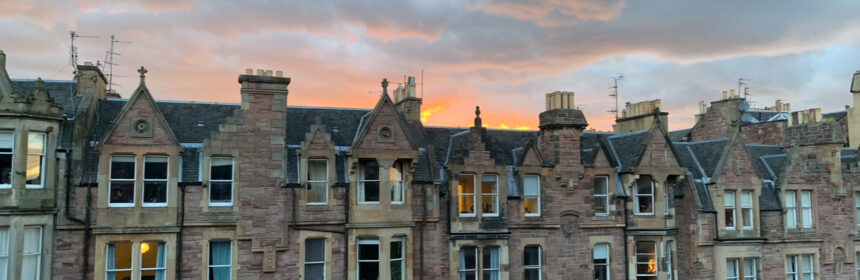
Header image: Edinburgh sunset by Charlotte Ness is licensed under CC BY-SA 4.0
